Tokina at-x 11-20mm F/28 Pro Dx Lens Review
 Buy the Tokina 11-20mm f/2.eight Pro DX (Nikon) from B&H for $599
Pre-Order / Purchase the Tokina 11-20mm f/two.8 Pro DX (Canon) from B&H for $599
Tokina's ultra-wide lenses have a bully rail tape of being killer alternatives to name-make options. This became clear the day they delivered the first Tokina DX ultra-wide lens, the 12-24mm f/4 DX. Then came the faster, wider 11-16mm f/2.8 DX, and they simply couldn't manufacture them fast enough. Fast forward a few years, and the 11-16mm got a soft refresh (with a born AF motor too, for Nikon shooters), while the now-legendary 12-24mm f/4 DX got a fantastic successor: the 12-28mm f/4 DX. On the full-frame front, Tokina also wowed u.s. similarly with f/iv and f/2.viii ultra-wide zooms that held their own quite well confronting whatsoever name-brand choice.
Therefore, Tokina'due south 11-20mm f/2.8 DX should come as no surprise, just like its incredible performance should come as no surprise.
 Tokina eleven-20mm f/ii.8, Nikon D5300, Hand-held
SLR Lounge Preset Organisation, Lightroom five
Spoiler Warning: If you've read our initial report on the Tokina eleven-20mm f/2.viii, found hither, so you already know that things are looking very positive for this lens. For the near part, that initial impression stands firm – this lens is a stellar performer, and a worthy update to the 11-16mm.
We have a full video review, and a written review below. Savour!
[RELATED: Tokina announces new 11-20mm f/2.viii Pro Lens]
Watch The Video Review For The Tokina 11-20mm f/two.8

For lenses, we mainly focus on optical quality when information technology comes to the "Performance" category. Nevertheless, information technology is likewise worth zero the autofocus performance also, so earlier we talk near pixel-peeping, I'll say that the Tokina 11-20mm autofocused every bit expected for an ultra-wide lens: accurately, reliably, but not necessarily lightning fast. If it were a 24-seventy or 70-200, I might knock half a star off for it not being as snappy and responsive equally a Canon or Nikon (just like how most Tamrons and Sigmas are ever-and so-slightly slower, too), but since this is an ultra-wide lens, I think it'due south just fine.
Okay, well-nigh the images! They're incredible. They're incredible from 11-20mm, from the dead-center to well past the rule-of-thirds area, and from f/ii.8 to f/8 to f/16.
I tested this lens on a Nikon D5300, a 24 megapixel sensor with no AA filter, which is pretty much the most detail-hungry sensor you could perhaps attach to this lens. In other words, anyone using a 12-18 megapixel sensor that does have an AA filter, set to be floored!
But a lens' optical operation is non just almost sharpness. Equally you saw in the video, the Tokina 11-20mm f/ii.8 can also brag nigh very depression flare characteristics (the bad kind of flare, the nasty little dots), as well as decently low, unproblematic-to-correct baloney. Actually to be honest, I've never seen an ultra-broad lens with such a perfectly even curvature to its distortion! If yous don't know what I'm talking almost, google "wide angle lens mustache distortion" and read up.
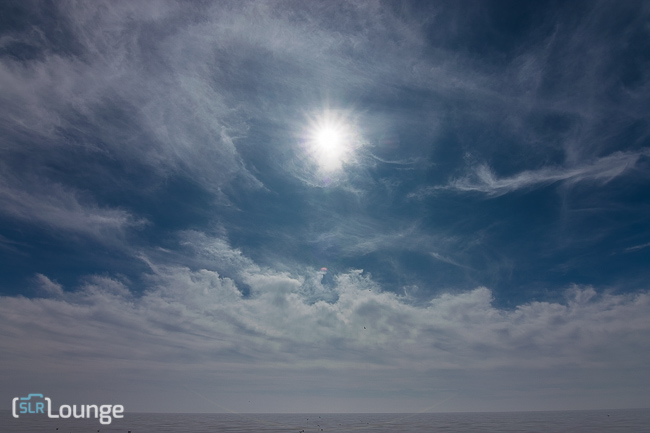

Chromatic aberration is present in the extreme corners, but low enough that Adobe's killer CA removal organisation does remove it quite nicely. In normal daylight or low-light weather there is no fringing present, however, in astrophotography conditions there may be a footling flake of haze nowadays outside the center of the frame. Withal, stars form very sharp points to well past the rule-of-thirds area, and blackout "wings" are small and chunky which is a good thing in my book.
Just about the merely complaint I have is that at (11-12mm but) the extreme, extreme corners (especially on the slightly more than demanding 1.5x crop sensor) accept a bit more of a sharp decline in overall sharpness, compared to the original eleven-16mm. This is probably less of an consequence for folks with the 1.6x crop format, and practically a non-upshot for anyone shooting 16:9 video or timelapse footage. But for still imagery shot wide open up, the farthermost, farthermost corners do fall apart until about f/5.six.


There are literally just a few pixels between this incredibly sharp prototype surface area, and the extreme corners that starting time to fall apart. For most photographers, no big deal. Astro-landscape shooters, however, might detect this to be a scrap of bummer.
Above are 100% crops, only below I've included a 100% crop (lower correct, see the video) that is re-sized past l%, so yous can see just how close perfect sharpness gets to the edges:


As I mentioned above, past f/5.6, the corners are looking pretty stellar! Unfortunately, I was non able to get my own personal copy of the 11-16mm f/2.8 returned to me in time to do a directly comparison. Nevertheless, I've stared at so many thousand images from that lens in these exact atmospheric condition, that I'm pretty confident in my verdict. Please comment below if you have any specific questions!
I'd say the optical performance is on par with most of the other course-leading ultra-wide options out in that location, both crop-sensor and total-frame. And it certainly leaves all other third-political party options far, far behind.

As I mentioned in my reviews of the Nikon 20mm f/one.8 Grand and Rokinon 12mm f/2.eight fisheye, a lens' "Features" rating commonly depends on how useful and versatile it is. Through no fault of its own, unfortunately, the more specialized a lens gets, the more it might lose a star for features (normally though, a more specialized lens should gain a star for offering a characteristic that no other lens tin can, so they might cancel themselves out)!
Suffice information technology to say that the Tokina eleven-20mm is "more of a good thing" in the features department. Information technology'south got more zoom. It's besides got a built-in AF motor for Nikon beginner DSLR users. It'due south got f/2.8, and is amazingly abrupt. Just about the only things we tin mutter nearly that might be considered features, actually fall into the "Design" category. Then, permit's move right along!
First, 1 question that I'd like to address earlier we move on is this: Does the 11-20mm have enough "features" for someone who already owns the 11-16mm to want to upgrade? If you own the oldest Tokina 11-16mm f/2.8, yous already own 1 of the sharpest crop-sensor lenses on the market, and the only f/2.eight ultra-wide zoom available for near, if not all, 1.5x and ane.6x DSLR systems. So, just enquire yourself, do you want 4mm on the long stop? Do you desire even more sharpness through the whole zoom range and at every aperture, except for the terminal few pixels of extreme corners wide open and at 11mm?
I'll exist the first to admit that many existing 11-16 owners may opt to just keep using their existing lens. I dearest mine, that'due south for sure! But if you're so inclined, or especially if you don't already own an ultra-wide lens for your crop-sensor camera, this lens is totally worth information technology.
 Tokina eleven-20mm @ 20mm, 16:9 crop
 Tokina 11-20mm @ 20mm, slight crop

I'll just say it: I don't want to buy 82mm filters. I would have been more than willing to bite the 82mm bullet if this lens had been a 10-16mm f/2.viii or 9-16mm f/two.8 instead of 11-20mm, or if it had been able to hit 11-24mm without any sharpness lost in the farthermost corners at 11mm.
Unfortunately, this is not the example, then I do experience inclined to knock a star off. If you already own one of the new 24-20 or other zooms that already made the jump to 82mm filters, then perhaps this isn't an outcome for you lot. But for most crop-sensor shooters to whom size and weight and price are ever a factor, I suspect information technology is an issue.
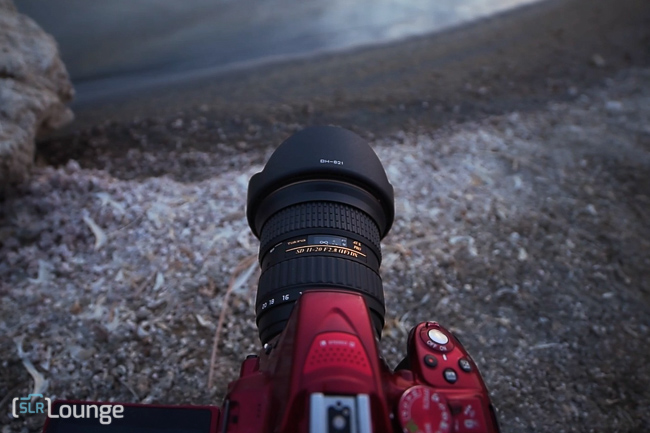
The only other nit-pick I accept nearly this lens' design is the rear element, as seen on a Nikon mount. Nikon has a problem with rear chemical element glass protruding a bit too far sometimes, and they usually solve this problem by calculation a small protective bump or tab to save the lens from consummate disaster if you were to (stupidly) put the lens down on a rough surface without the rear lens cap attached. The 11-20mm just doesn't have this protection, and if you lot zoom the lens but right, that rear chemical element will stick out just enough to brand me squirm. Most careful, non-then-reckless photographers won't see this every bit a problem, but if you're the kind of guy who just tosses stuff in a camera purse, or needs to ready a lens downwards on a rock once in a blue moon, delight beware!

Quality has always been 1 of Tokina's strengths. Most every 1 of their ultra-wide lenses has proven to be a stone-solid piece of kit that the average photographer will notice very difficult to harm, permit solitary destroy.
Tokina has historically used a bit more than metal in all their lens designs than any other tertiary party, and fifty-fifty more than Nikon or Canon in some cases.
The awesome matter is, the Tokina eleven-20mm is already so lightweight and compact, that size / weight nevertheless aren't a trouble.

Build quality is one thing; what near quality control?
While I exercise experience inclined to perform additional testing of an off-the-shelf Catechism version of this lens, to see if the extreme corners are any sharper (maybe I had a slightly de-centered copy), I think that quality command with Tokina has been, well, no worse than any other maker's generally lower modern standards (compared to say, the 80's when everything was made of metal, and lasted forever). QC is certainly better than an culling such as Rokinon, and I've heard less chatter about AF woes from Tokina than I have from Sigma or Tamron, so that's skillful. Simply similar I said, I've only tested one copy of the 11-20 so far.

When a lens offers sharpness on par with others costing 2-3 times every bit much, and trounces anything even remotely in a similar toll range, how can you not give it five stars for value?
The Tokina 11-20mm f/ii.viii DX is a poster child for everything that is good about crop sensors, and in my opinion, even offers a pretty compelling reason to stay with the DX crop even if you've been eyeing a full-frame upgrade!
The 11-16mm on my Nikon D300, and now my Nikon D5300, was the lens that satisfied my need for ultra-wide coverage, fifty-fifty when I upgraded to full-frame for certain needs.
I know that a dual-format sensor system isn't for everybody, nor are the budget / weight considerations as restricted. But owning both a crop and full-frame setup really works for me as an astro-landscape shooter who spends a lot of time traveling lite. And then, I highly recommend it to anyone who is on a budget and/or worried about saving weight & infinite in their pocketbook. (I'll get to who else might be interested in this lens, in the decision section below.)

Determination

But, who should purchase the Tokina 11-20mm f/two.8 DX? What is this lens' well-nigh straight competition? If you haven't already, read my initial thoughts on this lens, do so by clicking HERE. In short, I can't recommend whatsoever other crop-sensor lens more than than this 1. If you are on a super-duper tight budget, a make new mk1 (no AF motor on Nikon) Tokina 11-16mm is still in stock, and at $418, would save you almost a couple hundred bucks. If you enquire me, AF and the extra 4mm are worth information technology though.
If y'all really want more zoom ranage on the long end, and impossibly flawless farthermost corner sharpness, then maybe the existing Tokina 12-28mm f/4 DX is a amend choice, but personally the difference between 11mm and 12mm is more important than the departure between 20mm and 28mm. That, plus the f/2.8 vs f/4 thing. ;-)
Canon'due south aged 10-22mm f/iii.5-4.5 EF-S is a tad wider and longer, merely not nearly as abrupt.
Nikon's new-ish 10-24mm f/iii.5-4.v DX is likewise a tad wider and longer, only $200 more than expensive, and not nearly as sharp unless stopped downward all the way to f/seven-10.
With f/two.viii at your disposal and the ever-increasing image quality coming from ingather sensors these days (especially from the high ISO of cameras like the Canon 7D mk2, or the dynamic range of cameras like the Nikon D5300), you must actually ask yourself what is the best path for you.


In my opinion, full frame is no longer the only acceptable tool for a serious lensman, upgrading is no longer an inevitable progression like it was thought to exist just ~v years agone.
And so, option the system that is right for you, and option the lenses that get the chore done well. The Tokina xi-20mm f/2.8 is is absolutely ready for about whatsoever job.
Thanks for reading / watching and take care,
=Matt=
Buy the Tokina xi-20mm f/ii.8 Pro DX (Nikon) from B&H for $599
Pre-Order / Purchase the Tokina 11-20mm f/2.8 Pro DX (Canon) from B&H for $599
Source: https://www.slrlounge.com/tokina-11-20mm-f2-8-dx-review/
0 Response to "Tokina at-x 11-20mm F/28 Pro Dx Lens Review"
Post a Comment